Leah's Rescue Flare
Tinea and Leah: [Cyberpunk, Alien Incursions, Murder and Mayhem, Girl's Love (WLW)]Leah's Rescue Flare is the turning point in Leah's captivity: a deliberately chosen technological signal that transforms endurance into action and isolation into discoverability. Its importance lies not merely in announcing Leah's location, but in showing how Ypsilon and Leah use the point economy under conditions designed to make Leah feel powerless. The flare is both a rescue device and a wager that a visible signal can break the kidnappers' control of the scene.
Design and Cost
Ypsilon presents the device as a Highlight Self-Launching Self-Displacing Flare, a specialized signal capable of escaping almost any enclosure. It launches from the place where it is activated, then teleports above that position to a variable height; even a mountain interior or a skyscraper basement cannot necessarily contain it. Its protection against being shot down by anyone on Earth is part of the package, as are the fuel and flight systems that let it rise and remain visible above the launch point.
The flare is expensive because Leah must first purchase access to its catalog for fifty points and then pay thirty points for the flare itself. Ypsilon notes that cheaper alternatives could be used sooner, but their reliability would be uncertain and the wrong choice might destabilize Leah further. The rescue plan therefore combines a technical calculation with a psychological one: the best signal is not the cheapest immediate option, but the one most likely to work when Leah's condition is deteriorating.
Waiting Under Captivity
The flare cannot be used at once. Leah receives a few points each day, and Ypsilon calculates that three additional days are required before the purchase becomes possible. Ypsilon suspects that the captors may not know about this daily income and may be trying to make Leah feel so small and helpless that she will eventually stop resisting, even after her points begin accumulating again. The delay thus becomes part of the captors' pressure, while the point system gives Leah a narrow, measurable route toward intervention.
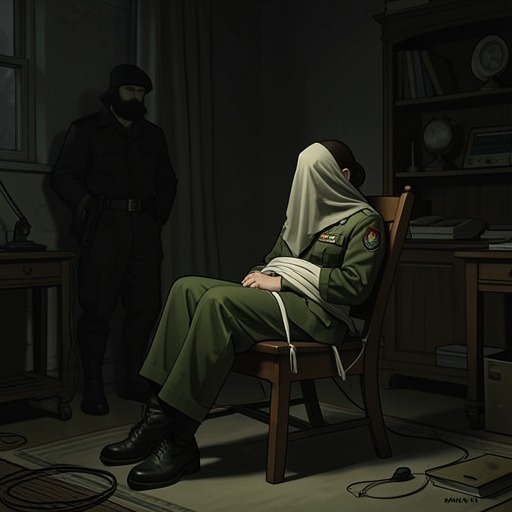
Leah holds on through repeated actions by her captors and through the increasingly oppressive conditions of confinement. On the sixth day after her kidnapping, Ypsilon tells her that she finally has enough points and asks whether she wants to buy and launch the flare. Leah is by then unsteady, delirious, faint, and increasingly unbound from ordinary stability. She cannot scream with relief because she has no voice, but she nods when she understands the offer, then freezes and shakes her head as though she still needs to clarify the decision. Her response makes the purchase a moment of recovered agency rather than a simple automated transaction.
Ypsilon offers an alternative: a drug or intervention that could keep Leah asleep for days or even weeks, at the cost of one point and an additional day of waiting before the flare becomes affordable. Leah chooses the signal instead. The choice places wakefulness, uncertainty, and the possibility of immediate rescue above temporary escape from consciousness. The flare is consequently tied to Leah's refusal to let captivity define the limits of her action.
Launch and Immediate Effect
Ypsilon counts down the final minute while Leah prepares to act. At zero, Leah activates the purchase and launch; the event is marked by a very quiet whoosh rather than a spectacular explosion. The Class I Search and Rescue Utilities catalog unlocks, Leah's points fall to forty, and the system records the new purchase as the Highlight Self-Launching Self-Displacing Flare. A Garbage Disposal is then purchased as well, reducing her remaining points to nine, but the rescue signal is the essential expenditure: it is the purchase that changes the strategic situation.
The result is immediate. The flare reaches its elevated position and displays exactly where Leah and Ypsilon are located. Ypsilon explains that the remaining problem is now simply waiting for someone to come, or finding a way to escape before help arrives. The language marks a decisive value shift. Before launch, Leah's location is controlled by the kidnappers and unknown to the outside world; afterward, the location is exposed and rescue has become an active possibility.
The signal also alters Leah's sensory and emotional environment. Only minutes after launch, someone lurches into the room and shouts for another person to come. Leah twitches at the sound because, after hearing Ypsilon speak to her continuously, a human voice other than Ypsilon's has become foreign and shocking. The flare therefore brings the outside world back into the room before it physically frees her: its first consequence is not immediate escape, but the rupture of the sealed auditory world in which captivity has confined her.
Narrative Function and Wider Pattern
Leah's Rescue Flare belongs to the book's recurring logic in which survival, combat, rescue, and self-transformation are translated into points, unlocks, purchases, and feedback. Elsewhere, Tynea reports combat through numerical results: one encounter records 420 targets eliminated, while the Foxteeth registers thirty-three rounds fired and sixty kills over sixteen seconds. Another battle leaves Tynea's counter at 1,008 points even as roughly a thousand or more Antithesis continue flowing into the city. Against that martial arithmetic, Leah's flare makes the point system serve preservation rather than destruction. The same economy that measures killing can also measure the price of being found.
The flare's operation also exposes the mixed agency of the Vanguard system. Leah makes the crucial decision, but Ypsilon supplies the catalog knowledge, calculates the waiting period, monitors Leah's condition, counts down the launch, and remains with her through the isolation. Rescue emerges from a partnership among Leah's endurance, Ypsilon's assistance, the flare's physical capabilities, and the kidnappers' failure to prevent its use. The device is not a passive prop: its ability to displace itself above an enclosed launch site is what defeats the architecture of confinement.
More broadly, Ypsilon's explanation of Vanguard behavior places the action within a culture that rewards experimentation and conditions chosen people to explore frightening possibilities. Vanguards tend to be go-getters because the system needs them not to revolt forever against the unknown; daredevils and adrenaline-seekers often continue indefinitely, while duty-bound figures such as Leah may remain active because their obligations tie them to others. Leah's flare embodies that pattern in a restrained form. She does not attack the facility or gamble on an uncertain cheap device. She waits, calculates, withstands the captors' pressure, and then commits scarce resources to the option designed to work no matter where she has been hidden.